
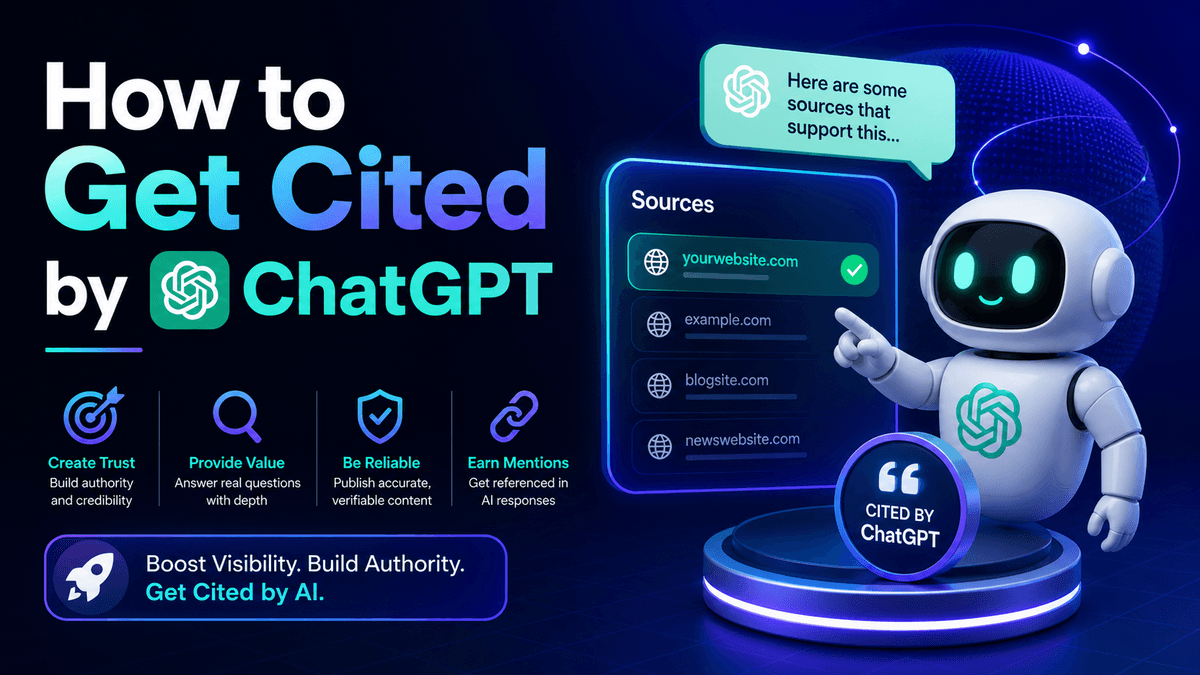
How to Get Cited by ChatGPT: A Complete 2026 Guide
Published: 2026-05-05 12:07:51
ChatGPT now has 900 million weekly active users and processes over 2.5 billion prompts every day. It drives 87.4% of all AI referral traffic to websites more than Gemini, Perplexity, and Claude combined. When someone asks ChatGPT "What is the best SEO agency in Delhi?" or "Which tool should I use for website development?", your brand is either part of that answer or it does not exist in that conversation.
This is the new reality of digital marketing in 2026.
Traditional SEO put you in a list of ten blue links. A ChatGPT citation puts you inside the answer itself with an implicit endorsement from an AI that hundreds of millions of people trust daily. Visitors who arrive from a ChatGPT citation are pre-educated and high-intent. They already read an AI summary that mentioned your brand, which means they convert at significantly higher rates than regular organic search visitors.
The challenge: most brands have no idea why ChatGPT cites some websites and completely ignores others. This guide closes that gap with a clear, actionable strategy you can start implementing today.
To understand modern SEO strategies, explore our detailed guide on Hybrid Engine Optimization.
How Does ChatGPT Actually Choose What to Cite? {#how-chatgpt-picks}
Understanding ChatGPT's citation logic is the foundation of everything that follows. ChatGPT does not rank pages the way Google does. It uses two distinct knowledge sources:
1. Training Data (Static Knowledge)
ChatGPT's base model was trained on massive datasets crawled from the web up to a specific cutoff date. Content that was present, well-structured, and widely referenced during that training window gets embedded into the model's memory. This is why Wikipedia accounts for nearly 47.9% of all ChatGPT citations — it was heavily included in training data.
2. Real-Time Web Search (Dynamic Retrieval)
When ChatGPT uses its web browsing capability (powered by OAI-SearchBot), it performs a live vector search — finding content that semantically matches the user's query. It then extracts clean, structured answers from those pages and synthesizes a response.
Both pathways reward the same core signals: entity clarity, content extractability, structured formatting, and third-party authority.
Importantly, approximately 90% of ChatGPT citations come from sources outside the top 20 Google search results. This means you do not need to be ranking #1 on Google to get cited by ChatGPT. You need to be clear, structured, trustworthy, and accessible to AI crawlers.
To build a successful career, explore the top high demand digital marketing skills you must learn today.
Ready to start your digital journey?
Call Us: 91 85278 66980
Email: info@codewithtls.com
Visit Us: 2/81-82, Ground Floor, Lalita Park, Laxmi Nagar, New Delhi
Step 1 — Give GPTBot and OAI-SearchBot Full Access {#step-1-access}
This is the most critical and most commonly overlooked fix. If ChatGPT's bots cannot crawl your site, nothing else in this guide will matter.
OpenAI sends two main bots to your website:
- GPTBot — crawls your site for training data
- OAI-SearchBot — retrieves pages in real time when users search with ChatGPT
Many websites accidentally blocked these bots in 2023 and 2024 out of concern about data scraping. In 2026, that decision is actively hurting your AI visibility.
Action: Open your robots.txt file at yourdomain.com/robots.txt and check for any rules blocking these bots. Your file should include:
User-agent: GPTBot
Allow: /
User-agent: OAI-SearchBot
Allow: /
If you see Disallow: / under either of these user agents, remove it immediately. Also verify that ClaudeBot and PerplexityBot are not blocked, since the same principle applies for visibility on Claude and Perplexity.
Once you allow access, check your server logs within 2–4 weeks. You should start seeing GPTBot and OAI-SearchBot visits — which confirms ChatGPT can now read your content.
To stay ahead in AI-driven search, read our complete guide on understanding AIO.
Step 2 — Build Clear Entity Identity {#step-2-entity}
ChatGPT understands the world through entities — nodes in a knowledge graph representing real people, brands, places, and concepts. Before ChatGPT can recommend or cite your business, it needs to confidently identify you as a distinct, trustworthy entity.
The biggest killer of AI citation is entity confusion. If your website describes you as a "Creative Partner," your LinkedIn calls you a "Digital Marketing Agency," and your Google Business Profile says "IT Consultant," ChatGPT cannot categorize you — so it will not cite you.
How to establish strong entity identity:
- Write a clear, factual About page that defines your brand, what it does, who it serves, and when it was founded
- Use identical brand descriptions across your website, LinkedIn, Google Business Profile, Crunchbase, and all directories
- Create or update your Wikidata entry with key properties: founding date, headquarters, industry, official website, and social identifiers — this is one of the highest-ROI actions for ChatGPT visibility
- Add Organization schema markup to your homepage (see Step 4)
- Write detailed author bios with credentials, areas of expertise, and links to social profiles — ChatGPT rewards content with verifiable human experts behind it
If your brand meets Wikipedia's notability guidelines, a well-sourced Wikipedia article is the single most valuable asset you can build for ChatGPT citations, since Wikipedia accounts for nearly half of all ChatGPT citations across topics.
Understand how rankings and user experience differ in this guide on the difference between SEO and SXO.
Step 3 — Write Answer Capsules (The #1 Citation Signal) {#step-3-answer-capsules}
An audit of 15 domains generating nearly 2 million organic monthly sessions and 7,500 direct ChatGPT referral sessions (Search Engine Land, November 2025) found one overwhelmingly consistent pattern: answer capsules were the single strongest predictor of ChatGPT citation.
An answer capsule is a short, self-contained paragraph — typically 2–4 sentences — that fully answers the main question of a section, placed immediately below a heading. It is written to stand alone without context, making it easy for ChatGPT to extract and quote directly.
Key findings from the audit:
- 34.3% of cited posts combined an answer capsule with original data — the strongest-performing configuration
- 38.0% had an answer capsule but no proprietary data — still significantly outperforming average
- Just 13.2% of cited posts lacked both a capsule and any original insight
- Over 90% of answer capsules in cited posts contained no links at all — keeping the capsule clean helps AI extract it without noise
How to write an effective answer capsule:
Write your heading as a question (e.g., "What is Hybrid Engine Optimization?"), then immediately follow it with a 2–4 sentence paragraph that directly answers that question. Keep it free of internal links, vague language, and marketing fluff. Think of it as writing a definition that could appear in an encyclopedia.
Example of a weak opening:
"There are many important factors to consider when thinking about how SEO has evolved over the years."
Example of a strong answer capsule:
"Hybrid Engine Optimization (HEO) is a unified strategy that combines traditional SEO, Answer Engine Optimization (AEO), and Generative Engine Optimization (GEO) — so your content ranks on Google and gets cited by AI tools like ChatGPT simultaneously. It was coined by Jori Ford at SEO Week 2025 in New York City."
Every important section of your content should open with an answer capsule. This is how you get cited consistently across multiple queries, not just one.
Confused about paid ads? Read our detailed comparison of Google Ads vs Meta Ads to choose the right platform.
Want to build a high-paying career in digital marketing?
Call: 91 85278 66980
Email: info@codewithtls.com
Visit: Lalita Park, Laxmi Nagar, New Delhi
Step 4 — Use Structured Data and Schema Markup {#step-4-schema}
Schema markup is code added to your pages that gives ChatGPT a machine-readable map of your content. When OAI-SearchBot crawls your site with structured data in place, it can extract specific facts — your business type, your services, your FAQ answers, your authors — with confidence and precision.
Essential schema types for ChatGPT citation:
| Schema Type | What It Does | Priority |
| Organization | Defines your brand as a known entity | Critical |
| Article | Marks content with author, date, and topic | Critical |
| FAQPage | Makes Q&A sections directly extractable | Critical |
| Person | Establishes author credentials and expertise | High |
| BreadcrumbList | Explains your site structure | High |
| HowTo | Marks step-by-step processes | High |
| Service | Defines your services for service businesses | High |
Implement these using JSON-LD format in the section of each page. Validate your schema using Google's Rich Results Test before publishing.
Additionally, consider adding an llms.txt file at yourdomain.com/llms.txt. This emerging standard — similar to robots.txt but designed for AI language models — provides a structured summary of your site, its key topics, and your most important pages. Early adoption gives you a measurable edge as AI crawlers evolve to use it.
Want to improve your local visibility? Check out our complete Google My Business ranking guide.
Step 5 — Publish Original Data and Owned Insights {#step-5-original-data}
ChatGPT heavily favors content with unique, verifiable facts it cannot generate independently. The core principle: ChatGPT can extract a specific number from your content. It cannot do anything with a vague marketing claim.
Replace this: "We are a leading provider of digital solutions."
With this: "We have delivered 4,500 projects across India with a 98% client satisfaction rate since 2018."
The second version gives ChatGPT a citable fact. The first gives it nothing.
Types of original data that drive citations:
- Case study results with specific numbers ("reduced load time by 62% in 3 weeks")
- Survey data and research from your own audience
- Before/after comparisons with measurable outcomes
- Year-on-year performance benchmarks
- First-hand experience summaries presented as "owned insights" (e.g., "Based on our analysis of 200 client sites...")
You do not need to commission a full research study. Even simple observations backed by specific numbers from your own work function as original data. The key is specificity — replace adjectives like "significant" and "large" with actual figures every time.
Start your digital journey with this complete guide on Google Digital Garage.
Have questions or need guidance?
Talk to our experts today!
📞 91 85278 66980 | 📧 info@codewithtls.com
📍 Visit us at Lalita Park, Laxmi Nagar, New Delhi
Step 6 — Build Third-Party Brand Authority {#step-6-off-site}
Your own website cannot carry your ChatGPT visibility alone. For top-of-funnel and category queries, approximately 85% of ChatGPT citations come from off-site sources — third-party publications, review platforms, directories, and community forums.
ChatGPT treats brand mentions across multiple independent sources as "consensus." One mention of your brand on your own website is a claim. The same fact mentioned consistently on Reddit, a G2 review, an industry blog, and a podcast interview becomes a verified truth in ChatGPT's knowledge model.
High-impact off-site citation sources:
- Wikipedia and Wikidata — the single most cited source in ChatGPT responses
- Industry directories — Crunchbase, Clutch, G2, Trustpilot, DesignRush, Justdial
- Reddit — answer questions in relevant subreddits authentically and consistently
- Quora — long-form expert answers on topics in your niche
- Guest articles — contribute original pieces to industry publications in your space
- Podcasts — being quoted or featured gives ChatGPT diverse independent confirmation of your expertise
- Press coverage — earned media from reputable sources dramatically increases citation likelihood
- LinkedIn long-form posts — these are indexed and cited by AI tools more than most brands realize
For Indian businesses and agencies, listings on platforms like IndiaMART, Sulekha, Justdial, and local business directories also contribute to the AI's confidence in your entity — especially for location-specific queries.
The goal is to create a consistent, diverse, off-site presence where your brand is described using the same language across many independent sources. Build consensus, not just a single anchor.
Discover how search suggestions work in our guide on Google Autocomplete for SEO.
Step 7 — Track and Measure Your ChatGPT Citations {#step-8-tracking}
You cannot optimize what you do not measure. Tracking ChatGPT visibility requires a different toolkit from traditional SEO.
Manual tracking (free):
Open ChatGPT and Perplexity weekly. Ask 5–10 questions your target audience would ask in your niche. Record whether your brand or website is cited. This low-tech method gives you ground-truth data faster than most tools.
Tools for AI citation tracking:
- Profound — tracks brand visibility across ChatGPT, Perplexity, and Gemini with share-of-voice metrics
- Otterly.AI — monitors AI mentions and tracks citation frequency over time
- LLMRefs.com — enter your domain to see if it is being cited across AI platforms
- SE Ranking / Semrush — now include Google AI Overview tracking
- Google Analytics 4 — filter referral traffic by chatgpt.com and perplexity.ai as source to measure actual AI-driven traffic to your site
Server log analysis:
Check your server logs for the user agents GPTBot and OAI-SearchBot. Track which pages they crawl most frequently — these are your strongest citation candidates. Pages that bots visit repeatedly but do not cite yet are optimization opportunities: they are accessible but not yet extractable enough.
Set a baseline today. Within 60–90 days of implementing this guide, you should see measurable changes in your AI citation frequency.
Can ChatGPT Cite Sources in MLA Format? {#mla-format}
This is a common question from students and researchers. ChatGPT can format citations in MLA, APA, Chicago, and other academic styles when you specifically ask it to. However, there are important limitations to understand.
What ChatGPT can do:
When given a source title, author, URL, and publication date, ChatGPT can accurately format a citation in any requested style. It can also help you build a bibliography or works cited list from source information you provide.
What ChatGPT cannot reliably do:
ChatGPT cannot guarantee the accuracy of citations it generates from its training data. It may produce citations that look correct but contain fabricated page numbers, incorrect publication dates, or slightly altered author names. This is called "hallucination" — and it is common in citation generation.
Best practice for academic use:
Always verify every citation ChatGPT produces against the original source. Use ChatGPT for formatting assistance, not as your primary source of bibliographic data. Tools like Zotero, Mendeley, and CitationMachine are more reliable for academic citation generation.
Which AI Tool Is Best for Citations? {best-ai-citation-tool}
Different AI tools handle citations differently. Here is a practical comparison:
| AI Tool | Citation Approach | Best For |
| Perplexity AI | Cites sources inline with numbered footnotes | Research and fact-checking |
| ChatGPT (with Browse) | Provides source URLs when web search is enabled | Conversational research |
| Google Gemini | Cites Google Search results with source links | Current news and real-time info |
| Claude (Anthropic) | References sources when web search is active | Long-form analysis and writing |
| Microsoft Copilot | Integrated with Bing for detailed source citations | Office productivity and research |
For academic or formal citations: Perplexity AI is generally considered the most citation-transparent tool, since it displays numbered source footnotes inline with every claim. This makes it easy to verify where each piece of information came from.
For brand visibility purposes: ChatGPT is the highest-priority platform due to its 900 million weekly users and dominant share of AI referral traffic. Optimizing for ChatGPT citations typically yields the highest volume of AI-driven visitors.
For getting your website cited: All AI tools use similar signals — entity clarity, structured content, third-party brand mentions, and crawler access. A strategy that earns you ChatGPT citations will also improve your visibility on Perplexity, Gemini, and Claude simultaneously.
Common Mistakes That Block ChatGPT Citations {#mistakes}
Mistake 1 — Blocking GPTBot in robots.txt
The most common and most costly error. Check your robots.txt today. If you blocked GPTBot in 2023 or 2024, you have been invisible to ChatGPT's training and real-time retrieval ever since.
Mistake 2 — Inconsistent brand descriptions
If your brand is described differently across your website, LinkedIn, Google Business Profile, and third-party listings, ChatGPT cannot confidently identify you. Consistency is the currency of AI citation — same name, same description, same category everywhere.
Mistake 3 — Writing vague, unextractable content
Generic claims like "industry-leading," "comprehensive solutions," and "customer-focused approach" give ChatGPT nothing citable. Replace marketing language with specific facts, numbers, and declarative statements at every opportunity.
Mistake 4 — No answer capsules
If every section of your content opens with a long introductory paragraph before getting to the actual answer, ChatGPT will skip past your page and cite a competitor who answers the question directly in the first two sentences.
Mistake 5 — Relying only on your own website
Without third-party validation — reviews, press mentions, directory listings, Reddit discussions — ChatGPT treats your self-claims with skepticism. Build your presence across independent sources to create the consensus the AI looks for.
Mistake 6 — JavaScript-heavy pages
If your key content is rendered by JavaScript and not present in the raw HTML, AI bots cannot read it. Make sure your most important content — headlines, definitions, key claims — is server-side rendered and visible in the page source.
FAQ: How to Get ChatGPT Citations {#faq}
How to get ChatGPT citations?
Getting ChatGPT citations requires giving GPTBot and OAI-SearchBot crawler access via robots.txt, establishing your brand as a clear entity with consistent descriptions across the web, writing answer capsules (short, self-contained paragraphs that directly answer questions), adding schema markup, publishing original data, and building third-party brand mentions on trusted platforms like Reddit, Clutch, G2, and industry publications.
Can I use ChatGPT for citations in academic work?
ChatGPT can help format citations in MLA, APA, Chicago, or other styles when you provide the source details. However, always verify citations against the original source, as ChatGPT can generate plausible-looking but inaccurate bibliographic details. For academic work, use ChatGPT as a formatting aid, not as a primary citation source.
Can ChatGPT cite sources in MLA format?
Yes, ChatGPT can format citations in MLA format when you ask it to. Provide the author name, title, publication, URL, and date, and ask ChatGPT to format it as an MLA citation. The output is generally accurate but should always be manually verified before submission, as ChatGPT sometimes generates incorrect publication dates or page numbers.
Which AI tool is best for citations?
Perplexity AI is considered the most citation-transparent tool for research, as it displays numbered source footnotes inline with every claim. ChatGPT with web browsing provides source URLs but requires enabling the browse feature. For getting your own website cited by AI tools, ChatGPT is the highest priority due to its dominant share of AI referral traffic globally.
How long does it take to get cited by ChatGPT?
Technical fixes like robots.txt updates and schema markup can produce results in 2–4 weeks. Content restructuring with answer capsules typically shows results within 1–3 months. Building off-site brand authority through third-party mentions is a 3–6 month strategy. For brands that update their training data presence, results depend on when OpenAI next updates its model — which can take 6–12 months to fully reflect new content.
Does Google ranking affect ChatGPT citations?
There is a correlation: pages that rank well on Google tend to be crawled more by AI bots, and ChatGPT's real-time search retrieval does consider authority signals. However, ChatGPT citations are not exclusively determined by Google rankings. Studies show approximately 90% of ChatGPT citations come from outside the top 20 Google results — so strong content structure, entity clarity, and off-site mentions can earn citations even for pages with modest organic rankings.
Start Getting Cited by ChatGPT Today
The shift from search engine rankings to AI citations is the biggest change in digital marketing since the move to mobile. The businesses that build AI visibility now — through clear entity identity, structured content, accessible crawling, and off-site brand authority — will dominate the next generation of search.
Your 7-day action plan to start:
- Day 1: Check and fix your robots.txt for GPTBot and OAI-SearchBot
- Day 2: Audit your brand descriptions for consistency across all platforms
- Day 3: Rewrite the intros of your top 5 pages as answer capsules
- Day 4: Add Organization, Article, and FAQPage schema to key pages
- Day 5: Create or update your Wikidata entry
- Day 6: Post one expert answer on Reddit or Quora in your niche
- Day 7: Set up ChatGPT and Perplexity manual tracking for your brand queries
About CodeWithTLS
CodeWithTLS is a full-service digital marketing and web development agency based in New Delhi, India. We specialize in AI-ready SEO strategies, HEO (Hybrid Engine Optimization), website development, and digital growth solutions that help businesses get found — on Google, in ChatGPT, and everywhere their audience searches.
📞 Call Us: +91 85278 66980
✉️ Email Us: info@codewithtls.com
🌐 Website: www.codewithtls.com
📍 Visit Us: 2/81-82, Ground Floor, Lalita Park, Gali No - 2, Laxmi Nagar, New Delhi – 110092