
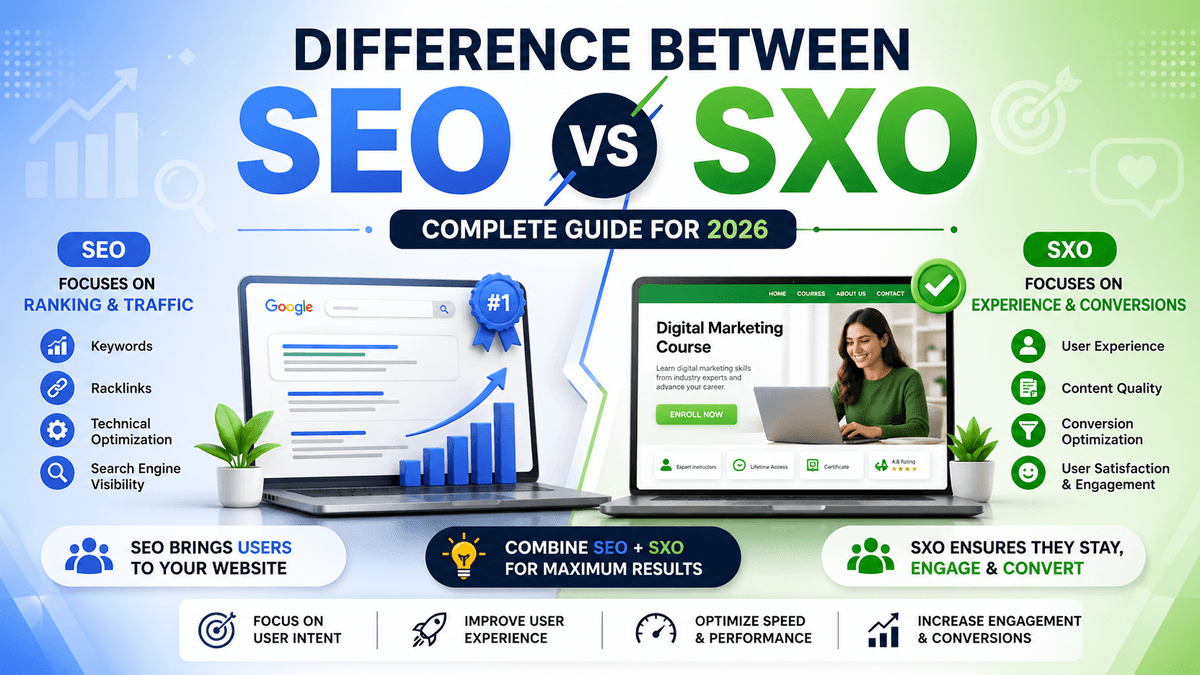
Difference Between SEO and SXO: Complete Guide for 2026
Published: 2026-04-27 11:01:03
In today’s digital landscape, just ranking on search engines is not enough. Businesses now need to attract, engage, and convert users. That’s where the debate of SEO vs SXO becomes crucial.
If you’re confused about the difference between SEO (Search Engine Optimization) and SXO (Search Experience Optimization), this detailed, SEO-friendly guide will help you understand everything from basics to advanced strategies.
Read our guide on strategies for improving agent experience and customer support optimization.
What is SEO (Search Engine Optimization)?
SEO (Search Engine Optimization) is the art and science of improving your website so it appears higher on search engines like Google Search right when people are actively looking for what you offer.
In simple terms: SEO helps your website get found online without paying for ads.
The Main Goal of SEO
To attract high-quality organic traffic people who are already interested in your product, service, or content.
Key SEO Techniques (That Actually Work)
✔ Keyword Research
Find what your audience is searching for (including primary and LSI keywords)
✔ On-Page Optimization
Optimize titles, meta descriptions, headings, and content structure
✔ Off-Page SEO
Build authority through backlinks and brand mentions
✔ Technical SEO
Improve website speed, mobile-friendliness, and indexing
✔ Content Optimization
Create valuable, user-focused content that answers real questions
Real-World Example
Imagine someone searches:
“best digital marketing course in Delhi”
If your website appears at the top of the results and gets clicks—
that’s SEO working perfectly.
Learn more about what is SXO and how it improves both SEO and user experience.
Why SEO Matters Today
- Increases visibility on search engines
- Drives free, consistent traffic
- Builds trust and credibility
- Supports long-term business growth
Bottom line: SEO is not just about rankings it's about connecting your business with the right audience at the right time.
What is SXO (Search Experience Optimization)?
SXO (Search Experience Optimization) is the next step beyond traditional SEO. While SEO focuses on bringing users to your website, SXO focuses on what those users experience once they arrive—and whether they take action.
In other words, SXO ensures that traffic doesn’t just visit your site, but engages, trusts, and converts.
Learn more about what is AXO and its role in modern SEO and AI search optimization.
How SXO Works
SXO integrates three critical elements:
- SEO (Search Engine Optimization): Drives relevant traffic to your website
- UX (User Experience): Ensures the website is easy to navigate, fast, and user-friendly
- CRO (Conversion Rate Optimization): Encourages users to take action, such as signing up or making a purchase
The Core Focus of SXO
Unlike SEO, which prioritizes visibility, SXO prioritizes user satisfaction and outcomes.
It answers key questions like:
- Does the page solve the user’s problem?
- Is the content easy to understand and navigate?
- Is the journey smooth enough to lead to a conversion?
Goal of SXO
The ultimate goal of SXO is simple:
To deliver a seamless, valuable experience that turns visitors into customers.
Learn more about AIO, GEO, AEO, and SXO and how they are shaping the future of SEO and AI search.
Why SXO Matters
Getting traffic without results is ineffective. SXO ensures that:
- Users stay longer on your site
- They interact with your content
- They complete desired actions
Simple Way to Understand SXO
If SEO brings people into your store, SXO ensures:
- They find what they need quickly
- They enjoy the experience
- They are confident enough to make a purchase
Bottom line: SXO transforms your website from just a traffic source into a conversion-focused digital experience.
Learn the key differences between Google Ads vs Meta Ads and choose the right platform for your business.
Core Difference Between SEO and SXO
The fundamental difference between SEO and SXO lies in where their focus begins and ends.
SEO (Search Engine Optimization) is designed to bring users to your website by improving visibility on search engines. It focuses on rankings, keywords, and traffic acquisition.
SXO (Search Experience Optimization) takes over from that point. It is designed to engage users, meet their expectations, and convert them into customers once they land on your site.
A Simple Way to Understand It
- SEO = Traffic
- SXO = Results
SEO gets people through the door.
SXO ensures they stay, interact, and take meaningful action.
Explore the most in-demand tech skills in India and boost your career in 2026.
Why This Difference Matters
A website can rank at the top of search results and still fail if users leave without engaging. That’s where SXO becomes critical it transforms visibility into value by focusing on user satisfaction, seamless navigation, and conversions.
In essence: SEO attracts attention, while SXO turns that attention into measurable outcomes.
SEO vs SXO: Side-by-Side Comparison
| Feature | SEO (Search Engine Optimization) | SXO (Search Experience Optimization) |
| Primary Goal | Higher rankings & traffic | User satisfaction & conversions |
| Main Target | Search engine algorithms | Human users & intent |
| Core Tactics | Keywords, backlinks, meta tags | UX design, speed, navigation |
| Key Metrics | Rankings, CTR, traffic | Bounce rate, dwell time, conversions |
| Focus | Visibility | Experience |
| Analogy | Billboard attracting people | Store experience converting them |
Understanding SXO as the Evolution of SEO
SXO is not a replacement for SEO it is a natural evolution of it. As search engines become smarter and user expectations grow, simply ranking on results pages is no longer enough. The focus has shifted from visibility alone to overall user satisfaction and outcomes.
SXO builds on the foundation of SEO by combining three critical elements:
- SEO (Visibility): Ensures your website appears in search results
- UX (Usability): Makes your website easy, fast, and enjoyable to use
- CRO (Conversion): Encourages users to take meaningful actions
Enroll in our professional digital marketing course to gain industry-ready marketing skills.
Why This Evolution Matters
Modern search engines like Google no longer rank websites based only on keywords or backlinks. They now evaluate how users interact with your site.
They prioritize:
- Helpful, intent-driven content that genuinely answers queries
- Strong page experience, including speed and mobile-friendliness
- User satisfaction signals, such as engagement and retention
The Bigger Picture
In the past, SEO was about optimizing for algorithms. Today, success depends on optimizing for real people.
SXO represents this shift:
- From traffic → to meaningful engagement
- From clicks → to conversions
- From rankings → to real business results
In essence: SEO gets your website discovered, while SXO ensures it delivers value at every step of the user journey.
Follow our on-page SEO checklist to optimize your website for better rankings and traffic.
Why SXO is Gaining Momentum in 2026
As digital competition increases and user expectations evolve, SXO is becoming a critical strategy for businesses that want more than just traffic. It focuses on delivering real value throughout the user journey from search to conversion.
1. Intent-Driven Optimization
SXO shifts the focus from keywords to user intent. Instead of just targeting search terms, it ensures your content directly answers what users are actually looking for.
This means:
- Creating content that solves real problems
- Structuring information for quick understanding
- Matching content with different stages of the user journey
The result is not just visibility, but relevance and trust.
Explore our ultimate digital marketing guide to learn SEO, ads, and social media strategies in one place.
2. Frictionless User Journey
SXO emphasizes a smooth and seamless experience from the moment a user clicks on your link to the final action they take.
This includes:
- Fast-loading pages that reduce waiting time
- Simple and intuitive navigation
- Clear and compelling calls-to-action
By removing friction, users are more likely to stay, explore, and engage with your website.
3. Better Return on Investment (ROI)
Driving traffic alone is no longer enough. If users leave without interacting, that traffic has little value.
SXO improves performance by:
- Reducing bounce rates
- Increasing time spent on the site
- Boosting conversions and lead generation
In practical terms, SXO ensures that the traffic you earn translates into measurable business results.
Explore our ultimate digital marketing guide to learn SEO, ads, and social media strategies in one place.
The Real Shift
SXO is gaining momentum because it aligns with how modern platforms like Google evaluate websites based on user satisfaction, engagement, and usefulness, not just technical optimization.
Key Components of SXO
To truly implement SXO, you need to focus on the elements that shape the entire user journey—from first click to final conversion. These components work together to ensure your website not only attracts visitors but also delivers a meaningful and effective experience.
1. User Experience (UX)
User experience is the foundation of SXO. If your website is difficult to use, visitors will leave—no matter how well it ranks.
A strong UX includes:
- Clean, modern, and distraction-free design
- Mobile responsiveness across all devices
- Easy readability with proper spacing and formatting
The goal is to make navigation intuitive and effortless, so users can find what they need without confusion.
Learn how to improve visibility with our Google My Business ranking guide for better local SEO results.
2. Content Quality
Content is not just about keywords anymore—it’s about value and clarity.
Effective SXO content should:
- Be helpful, humanized, and solution-focused
- Use structured headings for better readability
- Provide clear, direct answers to user queries
High-quality content builds trust and keeps users engaged longer.
3. Page Speed
Speed plays a critical role in user experience and engagement. Slow-loading websites increase frustration and lead to higher drop-off rates.
Optimizing page speed helps:
- Reduce bounce rates
- Improve user satisfaction
- Increase the chances of conversion
Even a few seconds of delay can significantly impact performance.
Learn how to build digital skills with Google Digital Garage free courses and certifications.
4. Conversion Optimization
At the core of SXO is the ability to turn visitors into customers or leads.
This involves:
- Strategically placed CTA (Call-to-Action) buttons
- Well-designed landing pages focused on specific goals
- Simple and user-friendly forms
The aim is to guide users smoothly toward taking action without unnecessary friction.
SEO vs SXO: Practical Example
Let’s take a real-world scenario to understand how SEO and SXO work differently.
Imagine you run a digital marketing course website and want to attract students searching online.
With SEO
You optimize your website for search engines like Google Search:
- Your page ranks on the first page of results
- Users click on your website
- You start getting consistent organic traffic
At this stage, SEO has done its job—it has brought visitors to your site.
- Learn how to boost your career with our free digital marketing course with certificate.
With SXO
Now the focus shifts to what happens after the click:
- Users stay longer because your content is clear and helpful
- They find your website easy to navigate
- They begin to trust your brand and expertise
- They take action—such as enrolling in your course or contacting you
This is where SXO makes the difference—it turns visitors into customers.
The Real Difference
SEO brings people to your website.
SXO ensures they stay, engage, and convert.
How to Combine SEO and SXO for Best Results
To succeed in 2026, relying on SEO alone is no longer enough. You need a combined strategy that not only brings users to your website but also ensures they stay, engage, and convert. That’s where the integration of SEO and SXO becomes essential.
Learn how to find keywords using Google Autocomplete for SEO in this guide.
Step 1: Optimize for Search Engines
Start by building a strong SEO foundation so your website can be discovered on platforms like Google Search.
Focus on:
- Using keywords strategically across your content
- Building high-quality backlinks to increase authority
- Optimizing metadata such as title tags and descriptions
This step ensures your website gains visibility and consistent organic traffic.
Step 2: Optimize for Users
Once users land on your site, their experience determines whether they stay or leave. This is where SXO begins to take effect.
Improve:
- Design and readability for a clean, distraction-free experience
- Visual elements to make content more engaging
- Page load speed to reduce frustration and drop-offs
The goal is to create a smooth, intuitive journey that keeps users engaged.
Confused between careers? Read software development vs digital marketing in India
Step 3: Optimize for Conversions
Traffic and engagement mean little without results. The final step is to guide users toward meaningful actions.
Focus on:
- Strong and clearly visible CTAs (Call-to-Action)
- A clear value proposition that communicates benefits instantly
- Trust signals such as reviews, testimonials, and case studies
This ensures your website doesn’t just attract visitors—it turns them into leads or customers.
The Complete Strategy
When combined effectively:
- SEO brings the right audience
- SXO enhances their experience
- Conversion optimization turns visits into results
Pro Tips for Beginners
If you're just starting with SEO and SXO, the goal isn’t to follow every tactic blindly—it’s to build a strategy that balances visibility with user experience. These practical tips will help you stay on the right track.
Focus on User Satisfaction, Not Just Rankings
Ranking on Google Search is important, but it’s only the first step. What truly matters is whether your content solves the user’s problem.
Ask yourself:
- Does my content answer the query clearly?
- Is it easy to understand and actionable?
When users are satisfied, rankings naturally improve over time.
Explore the best digital marketing courses in Delhi for career growth.
Write for Humans, Not Bots
Search engines have become smarter. They now prioritize natural, helpful, and well-structured content over keyword stuffing.
Instead of forcing keywords:
- Write in a conversational, human tone
- Focus on clarity and readability
- Use keywords naturally within context
Use Internal Linking Strategically
Internal links help both users and search engines navigate your website.
Benefits include:
- Better content discovery
- Increased time on site
- Improved SEO structure
Link related pages in a way that feels helpful—not forced.
Improve Mobile Experience
Most users now access websites through mobile devices. A poor mobile experience can lead to high bounce rates.
Ensure your website:
- Loads quickly on mobile
- Has responsive design
- Is easy to scroll and navigate
A smooth mobile experience directly impacts both SEO and SXO.
Track User Behavior with Analytics
Data helps you understand what’s working and what’s not. Tools like Google Analytics provide valuable insights.
Monitor:
- Bounce rate
- Time on page
- Conversion rates
- User flow
These insights allow you to continuously refine your strategy.
Why Learn SEO & SXO from Experts?
Understanding SEO and SXO conceptually is one thing—but applying them effectively in real-world scenarios is what truly builds expertise. Algorithms change, user behavior evolves, and strategies that worked yesterday may not work today. That’s why practical, expert-led training becomes essential.
Learning from industry professionals helps you:
- Understand how search engines and users actually behave
- Work on real campaigns instead of just theory
- Avoid common mistakes that beginners often make
- Build skills that are directly applicable in jobs or freelancing
Learn Digital Marketing with Industry Experts
If you want to master both SEO and SXO with hands-on experience, structured training can accelerate your growth.
At Code with TLS, you get:
- Live Projects
Work on real websites and campaigns to gain practical exposure - SEO SXO Training
Learn how to rank websites and convert traffic into results - Placement Assistance
Get support in building your career in digital marketing - Real-World Case Studies
Understand strategies that actually work in today’s market
Take the Next Step
If you're serious about building a career in digital marketing, the right guidance can make a significant difference.
Call Us: 91 85278 66980
Email Us: info@codewithtls.com
Visit Us:
2/81-82, Ground Floor, Lalita Park, Gali No - 2,
Laxmi Nagar, New Delhi - 110092
Contact Details
Call Us: 91 85278 66980
Email Us: info@codewithtls.com
Visit Us:
2/81-82, Ground Floor, Lalita Park, Gali No - 2,
Laxmi Nagar, New Delhi - 110092
👉 Start your digital marketing journey today!
FAQs: SEO vs SXO
1. What is the main difference between SEO and SXO?
SEO focuses on improving your website’s visibility on search engines to drive traffic, while SXO focuses on what users experience after they arrive—ensuring they engage, trust, and convert. In short, SEO brings visitors, SXO turns them into results.
2. Is SXO replacing SEO?
No, SXO is not replacing SEO—it is building on top of it. SEO remains essential for visibility, while SXO enhances performance by improving user experience and conversions. Both are most effective when used together.
3. Why is SXO important in 2026?
Search engines like Google now prioritize user satisfaction, helpful content, and page experience. Websites that only focus on rankings but ignore user behavior struggle to maintain performance. SXO ensures your site aligns with modern ranking factors and user expectations.
4. What are the key metrics of SXO?
SXO performance is measured using engagement and conversion-focused metrics such as:
- Bounce rate
- Dwell time (time spent on page)
- Conversion rate
- Pages per session
- User engagement signals
These metrics indicate whether users find your website useful and easy to interact with.
5. Can SEO work without SXO?
Yes, SEO can still drive traffic without SXO. However, the results are often limited. If users leave your site quickly or don’t take action, the traffic has little value. SXO ensures that your SEO efforts translate into meaningful outcomes like leads or sales.
6. How can I improve SXO?
Improving SXO involves enhancing the overall user journey:
- Optimize website design and usability (UX)
- Create clear, valuable, and well-structured content
- Improve page speed and mobile experience
- Add strong and visible CTAs
- Build trust with testimonials, reviews, and social proof
7. What is the role of user intent in SXO?
User intent is central to SXO. It ensures that your content matches what users are actually looking for, not just the keywords they type. When intent is properly addressed, users are more likely to stay, engage, and convert.
8. How does SXO improve conversion rates?
SXO improves conversions by removing friction and guiding users toward action. This includes:
- Clear navigation
- Fast-loading pages
- Persuasive content
- Strategic CTA placement
When users have a smooth experience, they are more likely to complete desired actions.
9. Is SXO only for large businesses?
No, SXO is beneficial for businesses of all sizes. Whether you run a blog, local business, or e-commerce site, improving user experience and conversions can significantly impact your results.
10. What tools can help with SXO?
Several tools can help analyze and improve SXO, including:
- Google Analytics for tracking user behavior
- Heatmaps (like Hotjar) to understand user interaction
- Page speed tools (like PageSpeed Insights)
- A/B testing tools for conversion optimization
Conclusion
SEO brings users to your website but SXO ensures they stay, engage, and convert. One drives visibility, the other delivers results.
A simple way to understand it:
If SEO is the engine, SXO is the overall driving experience. Without SXO, even the best engine won’t take you far.
To Succeed in 2026
✔ Combine SEO and SXO into a unified strategy
✔ Focus on real user intent, not just keywords
✔ Optimize the entire journey from search to conversion
Final CTA
Want to become an expert in SEO & SXO?
Join Code with TLS today and build a high-paying career in digital marketing!