
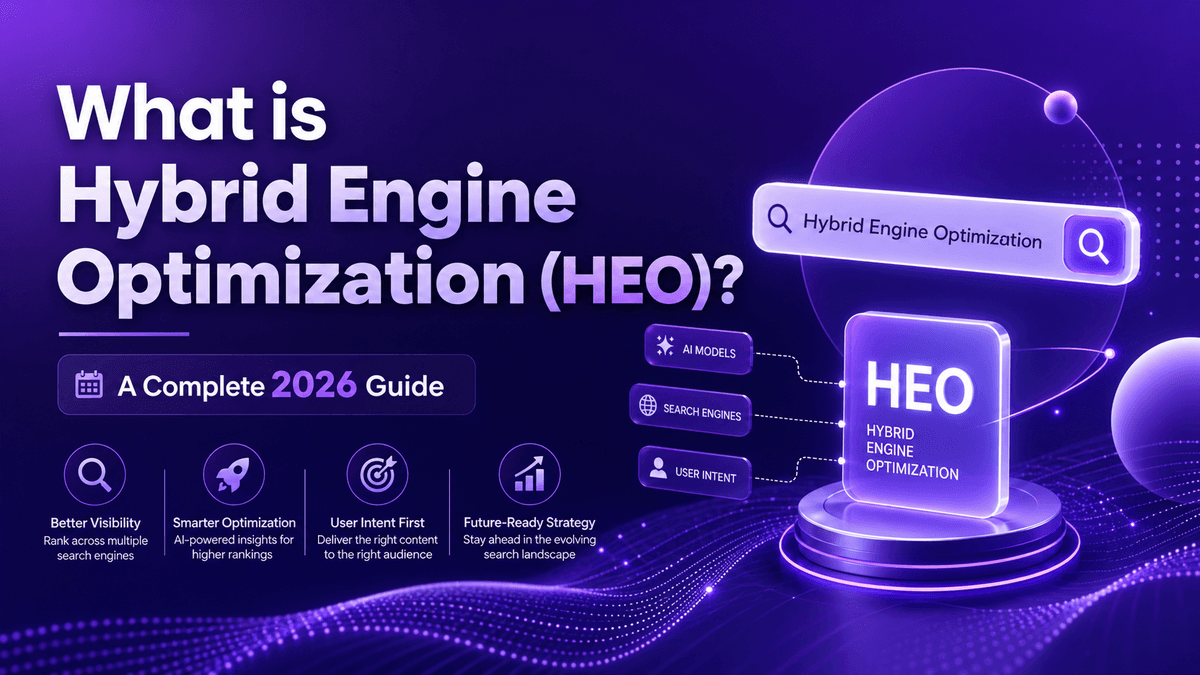
What is Hybrid Engine Optimization (HEO)? A Complete 2026 Guide
Published: 2026-05-05 11:20:22
Think about how you searched for something last week. Did you type three words into Google? Or did you ask ChatGPT a full question and get a ready-made answer back?
If you answered the second one — you are not alone.
Search has gone through its biggest transformation in thirty years. And if your digital strategy is still built around the old SEO playbook of 2020, you are already bleeding traffic — silently, every single day.
According to a Seer Interactive study, organic click-through rates for queries with Google AI Overviews dropped 61% between June 2024 and September 2025. Even pages ranking #1 are seeing dramatically fewer clicks. Meanwhile, ChatGPT now serves 900 million weekly active users, and Perplexity processes around 780 million queries per month.
Your audience is searching in places your current strategy doesn't touch.
That's why the smartest marketers and SEO professionals in 2026 are pivoting to a newer, more powerful framework: Hybrid Engine Optimization (HEO).
This guide will walk you through everything you need to know — what HEO is, where it came from, how it works, and exactly how to implement it to dominate both traditional search and AI-powered answer engines.
If you're new to AI-driven search, don’t miss our complete guide on AIO basics here:
👉 https://www.codewithtls.com/blogs/understanding-aio
What is Hybrid Engine Optimization (HEO)?
Hybrid Engine Optimization (HEO) is a unified digital marketing strategy that combines traditional SEO, Answer Engine Optimization (AEO), and Generative Engine Optimization (GEO) into one cohesive framework — so your brand gets found on Google AND gets cited inside AI tools like ChatGPT, Perplexity, and Gemini.
The keyword here is "hybrid."
HEO doesn't throw out everything SEO taught us. It expands on it. It takes keyword research, backlinks, technical health, and content quality — everything SEO already does well — and layers in the additional strategies needed to thrive in an AI-first search world.
Instead of running three separate, disconnected strategies (one for Google, one for featured snippets, one for AI tools), HEO gives you one master strategy that does all three simultaneously.
Want a clear understanding of how SEO and SXO differ in modern marketing? Read the full guide here:
👉 https://www.codewithtls.com/blogs/difference-between-seo-and-sxo
The Three Building Blocks of HEO
| Framework | What It Optimizes For | Primary Goal |
| SEO (Search Engine Optimization) | Google, Bing SERPs | Rank in the ten blue links |
| AEO (Answer Engine Optimization) | Featured snippets, voice search | Be the direct answer |
| GEO (Generative Engine Optimization) | ChatGPT, Gemini, Perplexity | Get cited in AI-generated answers |
| HEO (Hybrid Engine Optimization) | All of the above | Visibility everywhere people search |
Where Did HEO Come From? The History Behind the Term
The Origins of SEO (Mid-1990s)
The concept of Search Engine Optimization emerged in the mid-1990s when early search engines like Yahoo, AltaVista, and Google began indexing the web. The playbook was simple: pick keywords, build backlinks, optimize page titles, and wait for traffic. For two full decades, this worked.
The Rise of AEO (2017)
Around 2017, Google started serving direct answers at the top of search results — featured snippets, "People Also Ask" boxes, and voice assistant responses via Alexa and Google Home. Ranking #1 was no longer enough. You had to be the answer, not just rank near it. This gave birth to Answer Engine Optimization (AEO).
Looking to boost team productivity? Explore proven strategies for improving agent experience here:
👉 https://www.codewithtls.com/blogs/strategies-for-improving-agent-experience
The Birth of GEO (November 2023)
In November 2023, a landmark research paper titled "GEO: Generative Engine Optimization" was published on arXiv by researchers from Princeton University, Georgia Tech, The Allen Institute for AI, and IIT Delhi. The paper built a benchmark using 10,000 queries and tested nine optimization strategies.
The findings were groundbreaking: properly optimized content saw up to 40% better visibility in AI-generated responses. A page sitting at position #5 in Google saw a 115% visibility jump in AI answers when optimized correctly. GEO gave the SEO industry its first academic foundation for optimizing content for AI tools.
HEO is Coined (April–May 2025)
The term Hybrid Engine Optimization was coined by Jori Ford, Chief Marketing and Product Officer at FoodBoss, during her landmark talk at SEO Week 2025 in New York City, hosted by Mike King's agency iPullRank.
Her talk was titled: "Hybrid Engine Optimization: A Crawler Driven Approach to Maximizing Search & AI Visibility."
Ford deliberately chose the word "hybrid" because the SEO industry was getting overwhelmed with new acronyms — AIO, LLMO, GEO — each representing a sliver of the same puzzle. Her message: you don't need five different strategies. You need one unified strategy that covers everything.
"Hybrid just means it doesn't have to be that hard. We can figure out how to create balance." — Jori Ford, SEO Week 2025
By early 2026, HEO had become the working framework for modern search marketing across the industry.
New to modern SEO? Start by understanding what Search Experience Optimization (SXO) really means:
👉 https://www.codewithtls.com/blogs/what-is-sxo
Why HEO Matters Right Now: The Numbers You Can't Ignore
If you're still on the fence about whether HEO is relevant to your business, the data makes the case clearly:
Zero-click searches have hit 65% globally. For every 100 people who search on Google, roughly 65 leave without clicking any website — they got their answer from an AI Overview, a featured snippet, or an AI-powered answer engine.
Organic CTR has collapsed for AI Overview queries. Studies by Authoritas found a 79% CTR drop for top-ranking pages when AI Overviews appear. DMG Media reported internal CTR falling from 25.2% to just 2.8% — an 89% decline — for queries triggering AI answers.
AI-referred traffic converts better. Here's the upside: visitors who arrive from AI citations are pre-qualified. They've already read an AI answer that mentioned your brand, so they arrive with strong intent. Research from Onely suggests these visitors convert significantly better than average organic traffic — making every AI mention extremely valuable.
ChatGPT surpassed 900 million weekly active users in early 2026. That's more than double the 400 million it had in February 2025. Perplexity reached a $20 billion valuation in 2025. These are not niche tools — they are mainstream search destinations.
The bottom line: If you're not visible in AI-generated answers, you are invisible to a massive, fast-growing portion of your audience.
Curious about how AI is transforming search? Start by understanding what AXO (Agent Experience Optimization) is:
👉 https://www.codewithtls.com/blogs/what-is-axo
The 7 Pillars of Hybrid Engine Optimization
Think of these seven pillars as the complete HEO checklist — every important page on your website should pass all seven.
Pillar 1: Technical SEO Foundation
Nothing else in HEO works if the basics are broken. Both Google's crawlers and AI bots like GPTBot (ChatGPT), ClaudeBot (Anthropic), and PerplexityBot need to crawl and read your site without hitting obstacles.
What to audit and fix:
- Page speed: aim for under 3 seconds load time and LCP under 2.5 seconds
- Mobile usability: most AI-assisted searches happen on mobile
- Core Web Vitals: target INP under 200ms and CLS under 0.1
- Crawl errors and indexing gaps via Google Search Console
- Logical, consistent internal linking
- Critical: Check your robots.txt to confirm AI crawlers are NOT blocked
Many websites accidentally block GPTBot, ClaudeBot, or PerplexityBot in their robots.txt files. If an AI crawler can't read your site, ChatGPT or Perplexity cannot cite it. Check yours today at yourdomain.com/robots.txt.
Confused by modern marketing terms? Understand AIO, GEO, AEO, and SXO in one simple guide:
👉 https://www.codewithtls.com/blogs/what-aio-geo-aeo-and-sxo-actually-mean
Pillar 2: Topical Authority
AI tools don't just look at individual pages — they evaluate your entire website to determine if you are a trustworthy authority on a subject. A site with three shallow blog posts about SEO won't get cited. A site with 30 deeply researched, well-structured, interconnected articles on SEO will.
How to build topical authority:
- Choose a core topic and cover every major related question around it
- Build content clusters: one main pillar page supported by multiple in-depth subtopic pages
- Interlink all related pages logically so both humans and AI crawlers can follow the connections
- Update older content regularly to maintain accuracy and relevance
- Fill topical gaps your competitors haven't addressed
Pillar 3: Entity-Based Optimization
Traditional SEO optimizes for keywords. HEO optimizes for entities — clearly defined real-world things like a person, a brand, a service, or a concept. Google and AI tools understand the world through entities and their relationships, not just word patterns.
If your brand, authors, and services aren't clearly defined as entities, AI tools may not know who you are or what you do — and they won't cite you.
How to optimize for entities:
- Create a detailed About page that clearly defines your brand, mission, and team
- Create author bio pages with credentials, expertise areas, and links to social profiles
- Implement Organization schema and Person schema to formally establish entities
- Ensure your brand is described consistently across all platforms — same name, same description, same category
Confused about where to invest your ad budget? Learn the difference between Google Ads and Meta Ads in 2026:
👉 https://www.codewithtls.com/blogs/google-ads-vs-meta-ads
Pillar 4: Schema and Structured Data
Schema markup is code added to your pages that gives search engines and AI tools a labeled map of your content — instead of making them guess. It's one of the highest-ROI technical improvements you can make for HEO.
Essential schema types for HEO:
| Schema Type | Purpose |
| Article | Identifies content with author, date, and topic |
| FAQPage | Makes Q&A sections readable by Google snippets and AI tools |
| Person | Establishes author credibility as a real entity |
| Organization | Defines your brand as a verified entity |
| BreadcrumbList | Helps AI tools understand your site structure |
| Service | Describes your services clearly for AI tools |
Validate all schema using Google's Rich Results Test.
Pillar 5: Brand Mentions and Off-Site Citations
AI tools like ChatGPT and Perplexity don't just learn from your website — they learn from the entire web. Every time your brand is mentioned on a reputable blog, podcast, YouTube channel, Reddit thread, or industry forum, it adds to your authority in the eyes of AI tools.
This is "off-page entity building" — and unlike traditional link building, the mentions don't even need to include a clickable link to count.
How to build brand mentions:
- Contribute guest articles to industry publications
- Appear on podcasts as a subject matter expert
- Answer questions genuinely on Reddit, Quora, and LinkedIn
- Get featured in expert roundup articles
- Build a consistent LinkedIn presence with original insights
Research by Seer Interactive found that brands cited in AI Overviews earn 35% more organic clicks and 91% more paid clicks compared to brands that are not cited — a massive competitive advantage.
Planning a future-proof career? Explore the most in-demand tech skills in India for 2026 here:
👉 https://www.codewithtls.com/blogs/in-demand-tech-skills-in-india
Pillar 6: Conversational Content Formatting
AI tools extract answers by scanning your pages for clean, self-contained, quotable sections. If your content is written in long, dense paragraphs with no clear structure, it will be passed over in favor of better-formatted pages.
HEO content formatting rules:
- Write subheadings as questions: "How does HEO work?" instead of "HEO Working Process"
- Open each section with a 2–4 sentence direct answer before elaborating
- Keep paragraphs short — 3 to 5 sentences maximum
- Use numbered lists and bullet points where they aid clarity
- Add a FAQ section at the end of every important page
- Write conversationally — avoid jargon unless you define it clearly
Think of every section as a mini Q&A: question in the heading, direct answer in the opening paragraph, deeper detail in the section body.
Want to rank higher on Google? Follow this complete on-page SEO checklist for better optimization:
👉 https://www.codewithtls.com/blogs/on-page-seo-checklist
Pillar 7: Crawl Log Analysis
This is the pillar that separates advanced HEO practitioners from beginners — and it was the centerpiece of Jori Ford's original HEO framework.
Your server's crawl logs are a record of every bot that has visited your site. By analyzing them, you can discover:
- Which AI bots are crawling your site (GPTBot, ClaudeBot, PerplexityBot, Googlebot)
- How frequently each bot visits
- Which pages AI crawlers read vs. which they ignore
- Whether you're accidentally blocking AI crawlers in your robots.txt
Tools like Screaming Frog Log File Analyser, Botify, or even raw server log parsing can reveal this data. This is actionable intelligence that no other metric provides.
New to online marketing? Start with this ultimate digital marketing guide for beginners:
👉 https://www.codewithtls.com/blogs/ultimate-digital-marketing-guide
How to Write Content That AI Tools Actually Cite
The single most important content rule for HEO: write for humans first, structure for machines second.
AI tools are trained on natural human language. They prefer content that sounds trustworthy, authoritative, and genuinely helpful — not keyword-stuffed or mechanically optimized.
Proven content tactics for HEO:
Use direct answer paragraphs. Open every section with 2–4 sentences that fully answer the heading's implied question. This is the text AI tools extract and quote.
Include original data and insights. AI tools heavily favor content with unique statistics, first-hand experience, and original research. Recycled information rarely gets cited. Run your own tests, share client results, and document your observations.
Cite credible third-party sources. When you back claims with references to reputable studies, AI tools treat your content as more trustworthy and accurate — exactly the signal they're looking for.
Use plain, clear language. Complex sentences and unexplained jargon confuse both readers and AI parsing systems. Write as if explaining to a smart friend who isn't a specialist in your field.
Always add a FAQ section. FAQs are among the most reliably cited content formats in AI tools — structured, direct, and easy to parse. Every key page should end with one.
Planning to join a course? Check the latest digital marketing course fees in Delhi before enrolling:
👉 https://www.codewithtls.com/blogs/digital-marketing-course-fees-delhi
The llms.txt File: The New robots.txt for AI
A newer HEO tactic worth knowing is the llms.txt file. Similar to robots.txt, it sits at yourdomain.com/llms.txt and gives AI language models a structured summary of your site — what it covers, who you are, and which pages are most important.
Think of it as a welcome note for AI crawlers.
While the standard is still evolving and not all AI tools support it yet, adding one is low-effort and could give you a meaningful early-mover advantage. Include a brief brand description, your core topic areas, and links to your most important pages.
Want to start learning for free? Explore everything about Google Digital Garage courses and certifications here:
👉 https://www.codewithtls.com/blogs/google-digital-garage
Step-by-Step HEO Implementation Plan
Here's a practical action plan you can start this week:
Step 1: Run a full SEO audit
Use Screaming Frog, Ahrefs, or SEMrush to uncover crawl errors, slow pages, indexing gaps, and broken links. Fix critical issues first.
Step 2: Audit your robots.txt for AI crawlers
Go to yourdomain.com/robots.txt and confirm GPTBot, ClaudeBot, and PerplexityBot are not blocked. If they are, remove those rules.
Step 3: Reformat your top 10 pages with HEO structure
Add a direct-answer paragraph below each main heading. Add a FAQ section at the bottom. Make each section self-contained.
Step 4: Implement schema markup
Install Article, FAQPage, Person, and Organization schema on all key pages. Validate with Google's Rich Results Test.
Step 5: Build your entity presence
Update your About page and author bios. Ensure your brand is described consistently everywhere online.
Step 6: Earn off-site brand mentions
Write one guest article this month. Answer questions on Reddit or Quora in your niche. Get your brand featured somewhere your audience trusts.
Step 7: Track AI visibility weekly
Open ChatGPT, Gemini, and Perplexity. Ask questions related to your industry and check if your brand appears. Use tools like Semrush, SE Ranking, Profound, or Otterly.AI for more systematic tracking.
Want to find hidden keywords? Learn how Google Autocomplete helps in SEO keyword research:
👉 https://www.codewithtls.com/blogs/google-autocomplete-for-seo
Measuring HEO Success: New KPIs for 2026
Classic SEO metrics like keyword position and CTR are no longer the complete picture. Here are the KPIs that matter for HEO:
| Metric | How to Track |
| AI Overview appearance rate | Semrush, SE Ranking, Ahrefs |
| Brand mentions in AI tools | Manual testing in ChatGPT/Perplexity/Gemini |
| Branded search volume growth | Google Search Console |
| Direct traffic from AI platforms | GA4 referrer data (ChatGPT.com, Perplexity.ai) |
| Time on page & scroll depth | GA4 engagement metrics |
| Schema rich result impressions | Google Search Console |
4 Common HEO Mistakes to Avoid
Mistake 1: Treating HEO as a replacement for SEO
HEO is built on top of SEO — not instead of it. Strong Google rankings significantly increase the probability of appearing in AI-generated answers. Keep doing keyword research, technical audits, and link building.
Mistake 2: Writing only for bots, not for humans
Mechanically stuffing AI tool names or over-engineering your content for crawlers produces unreadable pages. AI tools are trained on human language — they reward natural, helpful writing.
Mistake 3: Ignoring off-site brand building
Your website alone is not enough. If AI tools can't find mentions of your brand across the web, they have no way to verify your authority. Invest in third-party platforms consistently.
Mistake 4: Not checking if AI bots can crawl your site
This is the single most common and costly mistake. Check your robots.txt right now. If GPTBot is blocked, ChatGPT cannot cite you — full stop.
Looking for the right institute? Explore the best digital marketing courses in Delhi with placement support:
👉 https://www.codewithtls.com/blogs/best-digital-marketing-courses-in-delhi
HEO vs. SEO vs. AEO vs. GEO: Clear Comparison
| SEO | AEO | GEO | HEO | |
| Year coined | Mid-1990s | ~2017 | Nov 2023 | Apr–May 2025 |
| Optimizes for | Google, Bing | Featured snippets, voice | ChatGPT, Perplexity | All of the above |
| Core tactics | Keywords, backlinks, technical SEO | Short answers, FAQ schema | Original data, entity authority | All combined |
| Goal | Rank in SERPs | Be the direct answer | Get cited by LLMs | Visibility everywhere |
The Future of HEO: What's Coming After 2026
HEO is not a passing trend — it's a response to a permanent, structural shift in how people find information.
Within the next few years, virtually every major search experience will blend traditional results with AI-generated answers. More importantly, agentic AI — tools that browse the web, compare options, and take actions on behalf of users — is already being tested by every major tech company.
Soon, your content won't just be read by humans. It will be parsed by AI agents making purchasing decisions, booking appointments, and comparing services. The brands that build strong entity authority, clean technical foundations, and genuine topical depth now will be the ones those agents recommend and trust.
The window to establish authority before your competitors is open. It will not stay open forever.
New to digital marketing? Start your journey with the best digital marketing course for beginners in Delhi:
👉 https://www.codewithtls.com/blogs/digital-marketing-course-for-beginners-in-delhi
Frequently Asked Questions About HEO
What is Hybrid Engine Optimization (HEO)?
HEO is a unified search marketing strategy that combines traditional SEO, Answer Engine Optimization (AEO), and Generative Engine Optimization (GEO) into one framework. It ensures your brand ranks on Google while also getting cited by AI tools like ChatGPT, Perplexity, and Gemini.
Who coined the term Hybrid Engine Optimization?
The term was coined by Jori Ford, Chief Marketing and Product Officer at FoodBoss, during her talk at SEO Week 2025 in New York City (hosted by iPullRank, April–May 2025).
Is HEO different from SEO?
Yes — HEO includes traditional SEO but goes further. It adds strategies specifically for AI-powered answer engines and generative AI tools, which traditional SEO does not address. Think of HEO as SEO evolved, not replaced.
What is the difference between GEO and HEO?
GEO (Generative Engine Optimization) focuses specifically on getting cited by AI tools. HEO is broader — it includes GEO, but also covers traditional Google rankings (SEO) and featured snippet optimization (AEO). HEO is the complete framework; GEO is one component of it.
Do I need to stop SEO and start HEO?
No. HEO builds on SEO. Continue keyword research, link building, and technical optimization — then layer in GEO and AEO strategies on top. HEO is expansion, not replacement.
How long does it take to see HEO results?
Technical fixes and schema changes can show impact within weeks. Content and entity improvements take 3–6 months for meaningful AI visibility. Brand mention strategies take the longest but have the most lasting impact.
What is an llms.txt file?
It's a file placed at yourdomain.com/llms.txt that helps AI language models understand your site's structure, purpose, and most important content. Similar in concept to robots.txt, it's designed specifically for LLMs.
Why is brand authority more important than backlinks in 2026?
AI engines weigh brand mentions, expert authorship, original research, and consistency of information across the web — not just backlink count. Trust signals are now multi-dimensional and favor brands with genuine authority over those with merely optimized link profiles.
Ready to Implement HEO for Your Business?
At CodeWithTLS, we specialize in building future-ready digital marketing strategies that combine technical excellence with AI-era optimization. Whether you're starting from scratch or updating an existing SEO strategy for 2026, our team can help you build the kind of authority that gets your brand ranked on Google and cited in ChatGPT, Gemini, and Perplexity.
From technical SEO audits to entity-based content strategies and full HEO implementation, we'll help your brand become the trusted answer — everywhere your audience is searching.
Get in Touch with CodeWithTLS
📞 Call Us: 91 85278 66980
📧 Email Us: info@codewithtls.com
📍 Visit Us: 2/81-82, Ground Floor, Lalita Park, Gali No - 2, Laxmi Nagar, New Delhi - 110092
🌐 Website: www.codewithtls.com