
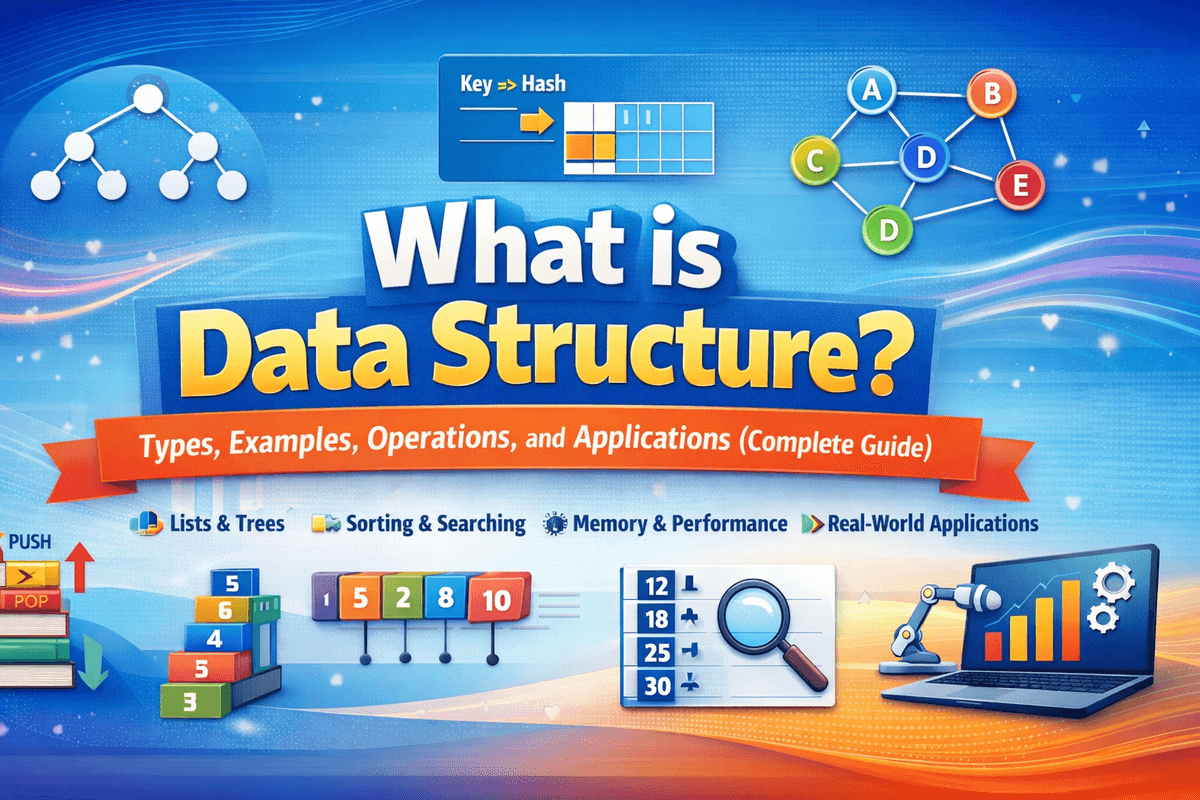
What is Data Structure? Types, Examples, Operations, and Applications (Complete Guide)
Published: 2026-02-06 13:25:36
If you are learning programming, the first fundamental topic you will encounter is data structure. Understanding what is data structure is essential because every program, app, or software uses data structures to store, organize, and process data efficiently.
In simple words, a data structure is a way to organize data in a computer so that it can be used effectively.
What is Data Structure?
A data structure is a smart way of storing and organizing data in memory so your program can find, add, remove, and arrange information quickly and efficiently.
Think of it like arranging books in a library. If books are scattered randomly, finding one takes forever. But when they’re organized on shelves by category and label, you can locate any book in seconds. Data structures do the same for data inside a computer.
Examples of common data structures: Arrays, Linked Lists, Stacks, Queues, Trees, Graphs, and Hash Tables.
Learn industry-relevant skills with our Data Science Course.
Why Do We Need Data Structure?
Data structures are the backbone of efficient programs. They help your software stay fast, organized, and scalable as data grows.
We use data structures to:
- Handle large volumes of data without chaos
- Perform operations faster like searching, inserting, deleting, and sorting
- Use memory wisely instead of wasting space
- Boost overall program performance
- Solve complex problems with cleaner, smarter logic
In short, the right data structure turns a slow, messy program into a quick, elegant solution.
Call Us
Email Us
Visit Us
2/81-82, Ground Floor, Lalita Park, Gali No - 2, Laxmi Nagar, New Delhi - 110092
Types of Data Structure
In linear data structures, elements are arranged sequentially, one after another. Each item has a clear predecessor and successor (except the first and last).
Examples:
- Array
- Linked List
- Stack
- Queue
These are simple to understand and ideal when data needs to be processed in a straight line.
Level up your coding skills with our DSA Course.
2) Non-Linear Data Structure
In non-linear data structures, elements are organized hierarchically or in a network-like pattern. One element can connect to multiple others.
Examples:
- Tree
- Graph
- Heap
- Trie
These are powerful for representing relationships, hierarchies, and complex connections in data.
What is Array in Data Structure?
An array is a linear data structure that stores a group of elements in contiguous (continuous) memory locations. Because the elements sit next to each other in memory, the computer can jump directly to any item using its position.
Key features:
- Fixed size: The length is decided when the array is created
- Indexed structure: Each element is accessed by its index (0, 1, 2, …)
- Fast access: You can retrieve any element instantly using its index
Think of an array like a row of lockers with numbers on them—if you know the locker number, you can open it immediately.
Start learning programming with our Python Basics guide.
Call Us
Email Us
Visit Us
2/81-82, Ground Floor, Lalita Park, Gali No - 2, Laxmi Nagar, New Delhi - 110092
What is Linked List in Data Structure?
A linked list is a linear data structure where elements (called nodes) are connected using pointers instead of being stored next to each other in memory. Each node holds data and a reference to the next node in the sequence.
This flexible linking makes linked lists great when you need frequent insertions or deletions.
Types of Linked Lists:
- Singly Linked List: Each node points to the next node only
- Doubly Linked List: Each node points to both the previous and the next node
What is Stack Data Structure?
A stack is a linear data structure that works on the LIFO (Last In, First Out) principle. The last element you put in is the first one that comes out just like a stack of plates.
You can perform two main operations:
- Push: Add an item to the top
- Pop: Remove the top item
Because access is restricted to the top, stacks are simple, fast, and very powerful in many scenarios.
Applications of Stack:
- Recursion: Function calls are managed using a stack
- Expression evaluation: Used in parsing and calculating expressions
- Undo/Redo operations: Tracks recent actions in editors and software
Check out our Best Generative AI Courses to upskill fast.
What is Queue in Data Structure?
A queue is a linear data structure that follows the FIFO (First In, First Out) principle. The element that enters first is the one that leaves first—just like people standing in a line.
You mainly perform two operations:
- Enqueue: Add an element at the rear
- Dequeue: Remove an element from the front
Queues are perfect when tasks must be handled in order.
Types of Queue
- Simple Queue: Standard FIFO queue
- Circular Queue: The last position connects back to the first, saving space
- Priority Queue: Elements are removed based on priority, not arrival time
- Deque (Double Ended Queue): Insert and delete from both ends
Applications of Queue
- Scheduling: CPU task scheduling and job management
- Printer queue: Documents print in the order they’re sent
- BFS traversal: Breadth First Search in graphs and trees uses a queue
In short, whenever order matters, a queue is your go-to data structure.
Learn how to earn with our Make $100/Day Affiliate Marketing blog.
Call Us
Email Us
Visit Us
2/81-82, Ground Floor, Lalita Park, Gali No - 2, Laxmi Nagar, New Delhi - 110092
What is Tree in Data Structure?
A tree is a hierarchical (parent–child) data structure that starts from a single root and branches out into multiple nodes. It’s perfect for representing structures like folders, organization charts, and decision flows.
Types of Trees
- Binary Tree: Each node has at most two children
- Binary Search Tree (BST): Left child < root < right child
- AVL Tree: A self-balancing BST for faster operations
- B Tree: A multiway search tree used in databases and file systems
Trees make searching, sorting, and hierarchical organization very efficient.
What is Graph in Data Structure?
A graph is a network-like data structure made of vertices (nodes) connected by edges. Unlike trees, graphs can form complex relationships and cycles—ideal for maps, social networks, and routing problems.
Graph Traversal
- DFS (Depth First Search): Explores as deep as possible before backtracking
- BFS (Breadth First Search): Explores level by level using a queue
In short, trees show hierarchy, while graphs model relationships.
Grow your income with our How to Make 1 Lakh/Month with Digital Marketing guide.
What is Hashing in Data Structure?
Hashing is a technique that uses a hash function to convert a key (like a name or number) into a fixed index in a hash table. This allows data to be stored and retrieved extremely fast, often in constant time.
- The hash function decides where the data should go
- A collision happens when two different keys get the same index
- Collisions are handled using methods like chaining or probing
Hashing is widely used in databases, password storage, caches, and dictionaries because of its speed.
Start here with our Basic Digital Marketing blog.
What is Heap in Data Structure?
A heap is a complete binary tree that follows a specific order:
- Max Heap: Parent node is greater than its children
- Min Heap: Parent node is smaller than its children
Heaps are mainly used to implement priority queues and are the foundation of heap sort. They are excellent when you frequently need quick access to the highest or lowest value.
What is Trie Data Structure?
A trie (pronounced “try”) is a special tree structure used to store strings efficiently. Each node represents a character, and words are formed by traversing from the root.
Tries are commonly used in:
- Dictionaries
- Autocomplete and search suggestions
- Spell checkers
They make prefix-based searches very fast and memory-efficient for large sets of words.
Learn earning strategies with our Amazon Affiliate Program India blog.
Call Us
Email Us
Visit Us
2/81-82, Ground Floor, Lalita Park, Gali No - 2, Laxmi Nagar, New Delhi - 110092
What is ADT (Abstract Data Type) in Data Structure?
An Abstract Data Type (ADT) describes what a data structure should do, without specifying how it does it. It focuses on the operations and behavior, not the internal implementation.
For example, a Stack ADT defines operations like push, pop, and peek but it doesn’t say whether the stack is built using an array or a linked list. That implementation detail is hidden.
ADT helps in writing clean, modular, and reusable code.
What is Sorting in Data Structure?
Sorting is the process of arranging data in ascending or descending order so it becomes easier to search, analyze, and process.
Common Types of Sorting
- Bubble Sort
- Selection Sort
- Insertion Sort
- Merge Sort
- Quick Sort
- Heap Sort
Different sorting algorithms are used based on data size, speed requirements, and memory usage.
Find solutions in our Students Struggle with Digital Marketing Tools blog.
What is Searching in Data Structure?
Searching is the technique of finding a specific element within a data set.
Types of Searching
- Linear Search: Checks each element one by one
- Binary Search: Efficient search on sorted data by dividing the list in half repeatedly
Sorting and searching together form the core of efficient data handling in programs.
What is Recursion in Data Structure?
Recursion is a technique where a function calls itself to solve a problem step by step. Each call waits for the next one to finish, and this chain of calls is managed internally using a stack.
It’s especially useful for problems that can be broken into smaller, similar sub-problems—like traversing trees, solving puzzles, or calculating factorials.
Explore our Learn Digital Marketing Course blog.
What is Time and Space Complexity?
When evaluating an algorithm, we care about two things: how fast it runs and how much memory it uses.
- Time Complexity: The time an algorithm takes to run, often expressed using Big O Notation (e.g., O(n), O(log n))
- Space Complexity: The amount of memory an algorithm requires during execution
These measures help us choose the most efficient solution for a problem.
What is Structured, Unstructured, and Semi-Structured Data?
| Type | Description | Example |
| Structured | Well-organized in rows and columns | Databases, spreadsheets |
| Unstructured | No predefined format | Images, videos, audio files |
| Semi-Structured | Some organization but flexible format | JSON, XML |
Understanding these data types helps in selecting the right storage method and data structure for processing them efficiently.
Operations on Data Structure
No matter which data structure you use, a few core operations are performed again and again to manage data effectively:
- Traversing: Visiting each element to process or display it
- Insertion: Adding a new element at a specific position
- Deletion: Removing an element from the structure
- Searching: Finding a particular element quickly
- Sorting: Arranging elements in a defined order
- Merging: Combining two data structures into one
These operations are the building blocks of how programs manipulate data.
Call Us
Email Us
Visit Us
2/81-82, Ground Floor, Lalita Park, Gali No - 2, Laxmi Nagar, New Delhi - 110092
Applications of Data Structures
Data structures power almost every area of computing. Some key applications include:
- Operating Systems: Process scheduling, memory management
- Databases: Indexing and fast data retrieval
- Artificial Intelligence: Graphs, trees, and heaps for decision-making
- Networking: Routing algorithms using graphs
- Web Browsers: Managing tabs, history (stacks and queues)
- Compiler Design: Syntax trees and parsing using stacks and trees
In short, wherever there is data, data structures are working behind the scenes to keep things fast and organized.
FAQs on Data Structure
Q1. What is data structure and algorithm?
A data structure is used to store and organize data, while an algorithm is a step-by-step procedure to process that data. Together, they determine how efficiently a program runs.
Q2. Which data structure is used for recursion?
Stack is used for recursion. Every recursive call is stored in the call stack until the function completes and returns.
Q3. Which data structure is non-linear?
Trees and Graphs are non-linear data structures because their elements are not arranged sequentially but in hierarchical or network form.
Q4. What is BST in data structure?
A Binary Search Tree (BST) is a tree where for every node:
left child < root < right child. This property makes searching very fast.
Q5. What is a node in data structure?
A node is the basic building block of many data structures. It contains data and one or more pointers (references) to other nodes.
Q6. What is asymptotic notation?
It is a mathematical method (like Big O Notation) used to describe the performance and complexity of an algorithm as input size grows.
Q7. What is sparse matrix?
A sparse matrix is a matrix in which most of the elements are zero. Special data structures are used to store it efficiently to save memory.
Q8. What is pointer in data structure?
A pointer is a variable that stores the memory address of another variable. It is heavily used in linked lists, trees, and graphs.
Q9. What is dynamic data structure?
A dynamic data structure can grow or shrink during runtime. Example: Linked List, where memory is allocated as needed.
Q10. How to master data structures and algorithms?
Start with basics (arrays, stacks, queues), understand concepts deeply, practice coding problems daily, and implement each data structure yourself to build strong logic.
Call Us
Email Us
Visit Us
2/81-82, Ground Floor, Lalita Park, Gali No - 2, Laxmi Nagar, New Delhi - 110092
Conclusion
Understanding what is data structure is the foundation of programming and software development. Mastering arrays, stacks, queues, trees, graphs, hashing, and sorting/searching techniques will help you solve real-world problems efficiently and crack coding interviews easily.
This single guide covers almost every important concept asked in interviews and exams related to data structures.